
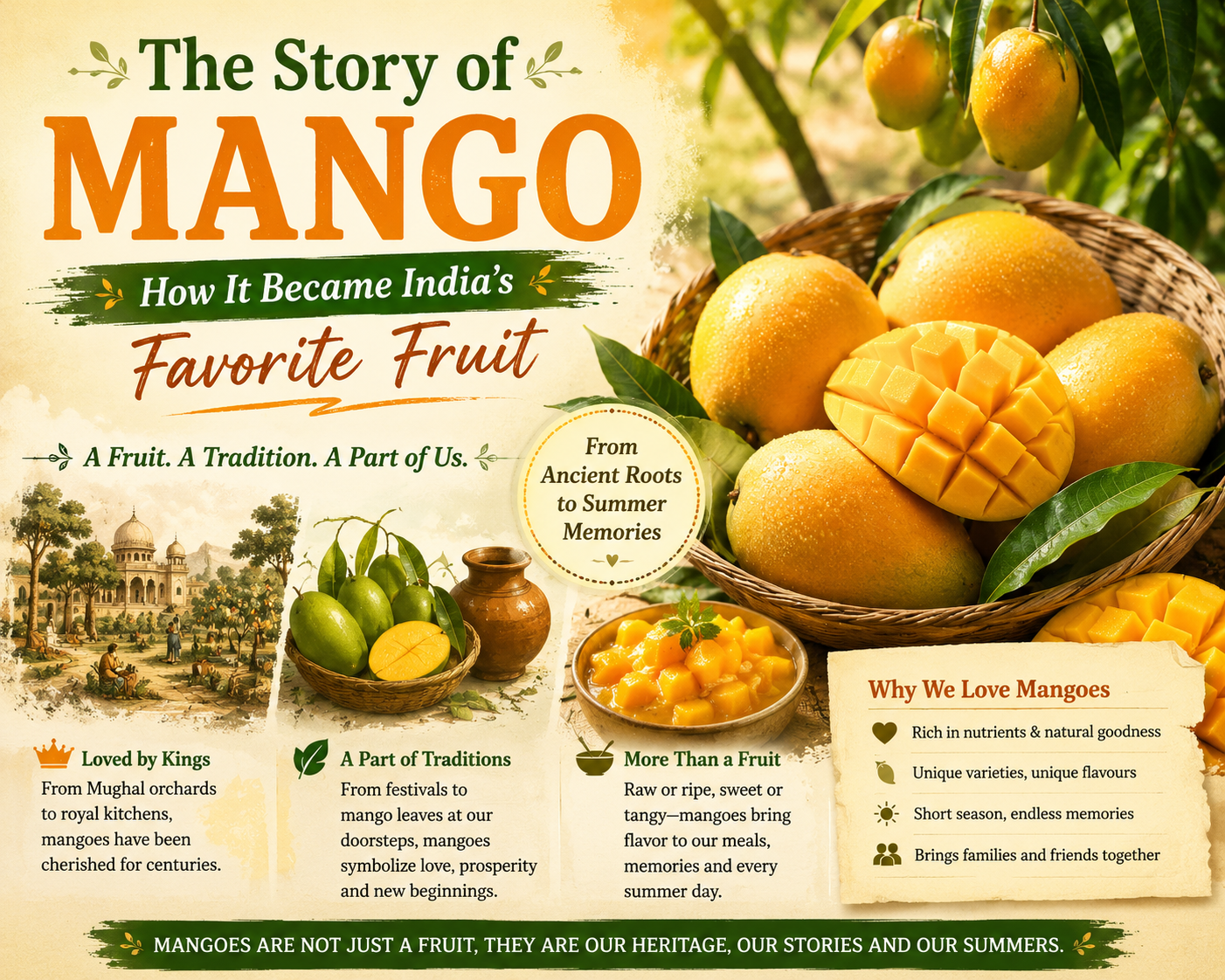
There’s something different about mango season in India.
The moment mangoes begin appearing in markets, everything changes a little.
People start discussing:
- Which variety arrived first
- Whether Alphonso is better than Dasheri
- How sweet this year’s mangoes are
- And when homemade pickles will finally be ready
Very few foods create this kind of excitement.
And while reading more about the history of everyday foods, I realized something interesting:
👉 Mango is not just a fruit in India.
It has quietly become part of memories, traditions, festivals, and even emotions across generations.
So I thought it would be interesting to gather some of these details together in one place.
🌳 A Fruit That Has Been Around for Thousands of Years
Mango is believed to have originated around the Indian subcontinent and nearby regions of South Asia.
Historical references suggest that mangoes were cultivated in India thousands of years ago.
Which means long before modern supermarkets and fruit packaging existed, mango trees were already part of Indian landscapes.
Over time, the fruit slowly became connected with:
- Summer traditions
- Hospitality
- Seasonal eating habits
- Family gatherings
And somehow, that connection still exists today.
👑 Even Kings Were Fascinated by Mangoes
One detail that really stood out to me was how much mangoes were admired during royal times.
During the Mughal era, mango cultivation became extremely popular.
Emperor Akbar is believed to have planted a massive mango orchard called Lakhi Bagh, which reportedly had thousands of mango trees.
It’s interesting to think that a fruit we casually cut and eat today was once so admired by kings and royal courts.
🥭 India Didn’t Just Grow Mangoes — It Created Mango Personalities
One of the most fascinating things about mangoes is how every region developed its own favorite variety.
And people become surprisingly loyal to them.
Some famous varieties include:
- Alphonso from Maharashtra
- Dasheri from Uttar Pradesh
- Langra from Varanasi
- Kesar from Gujarat
- Banganapalli from Andhra Pradesh
And if you ask people which one is best, the debate can go on for hours.
Because for many people, mangoes are personal.
☀️ Why Mango Season Feels Emotional
Unlike fruits available throughout the year, mangoes arrive for a limited time.
Maybe that’s part of what makes them special.
For many families, summer memories are tied to:
- Eating chilled mango slices in the afternoon
- Drinking aam panna during hot days
- Watching elders prepare mango pickle jars
- Storing boxes of mangoes wrapped in newspaper at home
Even the smell of ripe mangoes can remind people of childhood summers.
🍛 Mango Is More Versatile Than We Realize
Another thing I found interesting is how differently mango is used across India.
🥭 Raw Mango
Used in:
- Pickles
- Chutneys
- Aam panna
- Tangy summer dishes
🌞 Ripe Mango
Used in:
- Milkshakes
- Desserts
- Aamras
- Homemade sweets
- Or simply eaten fresh
Very few fruits fit into both spicy and sweet traditions so naturally.
🌿 Mango Beyond Food
Mangoes also became part of Indian traditions beyond eating.
Even today:
- Mango leaves are used during festivals
- They are placed near entrances during celebrations
- Mango motifs appear in Indian art and fabrics
Which shows how deeply the fruit entered cultural life over time.
✨ Simple Benefits People Associate with Mango
Without making things too technical, mangoes naturally contain:
- Vitamin C
- Vitamin A
- Fiber
- Natural sweetness
And because they are seasonal, many people enjoy them as part of balanced summer eating rather than an everyday fruit.
🧠 Why Mango Still Feels Different From Other Fruits
Reading about mangoes made me realize something:
People don’t just “consume” mangoes.
They wait for them.
They discuss them.
Compare them.
Gift them.
Remember summers through them.
And very few foods create that kind of emotional connection across an entire country.
🌟 A Small Reflection
From royal orchards to roadside fruit stalls, mango has traveled through centuries while still remaining deeply familiar.
Maybe that’s why it continues to feel special no matter how common it becomes.
🥭 Final Thought
Some foods simply become part of our diet.
Others slowly become part of culture, memories, and seasons.
And mango seems to have become all three.
📚 References
- Encyclopaedia Britannica – Mango
https://www.britannica.com/plant/mango-fruit-and-tree - National Horticulture Board (India)
https://nhb.gov.in/ - Indian Council of Agricultural Research (ICAR)
https://icar.org.in/
⚠️ Disclaimer
The information shared here is based on commonly available historical references, cultural observations, and general reading. It is meant for informational purposes only and should not be considered medical advice or nutritional guidance.