Tag: #FoodJourney

  • The Journey of Tomato: From a Wild Fruit to an Everyday Ingredient

    The Journey of Tomato: From a Wild Fruit to an Everyday Ingredient

    We use tomatoes almost every day—whether it’s in dal, sabzi, or chutney.

    But rarely do we stop and think about where they actually came from.

    While exploring more about everyday foods, I came across some interesting details about tomatoes. It made me realize that something so common in our kitchen has had quite an unexpected journey.

    So I thought it would be nice to bring these details together in one place.

    🌎 Tomatoes Didn’t Originate in India

    One of the most surprising things is that tomatoes are not originally from India.

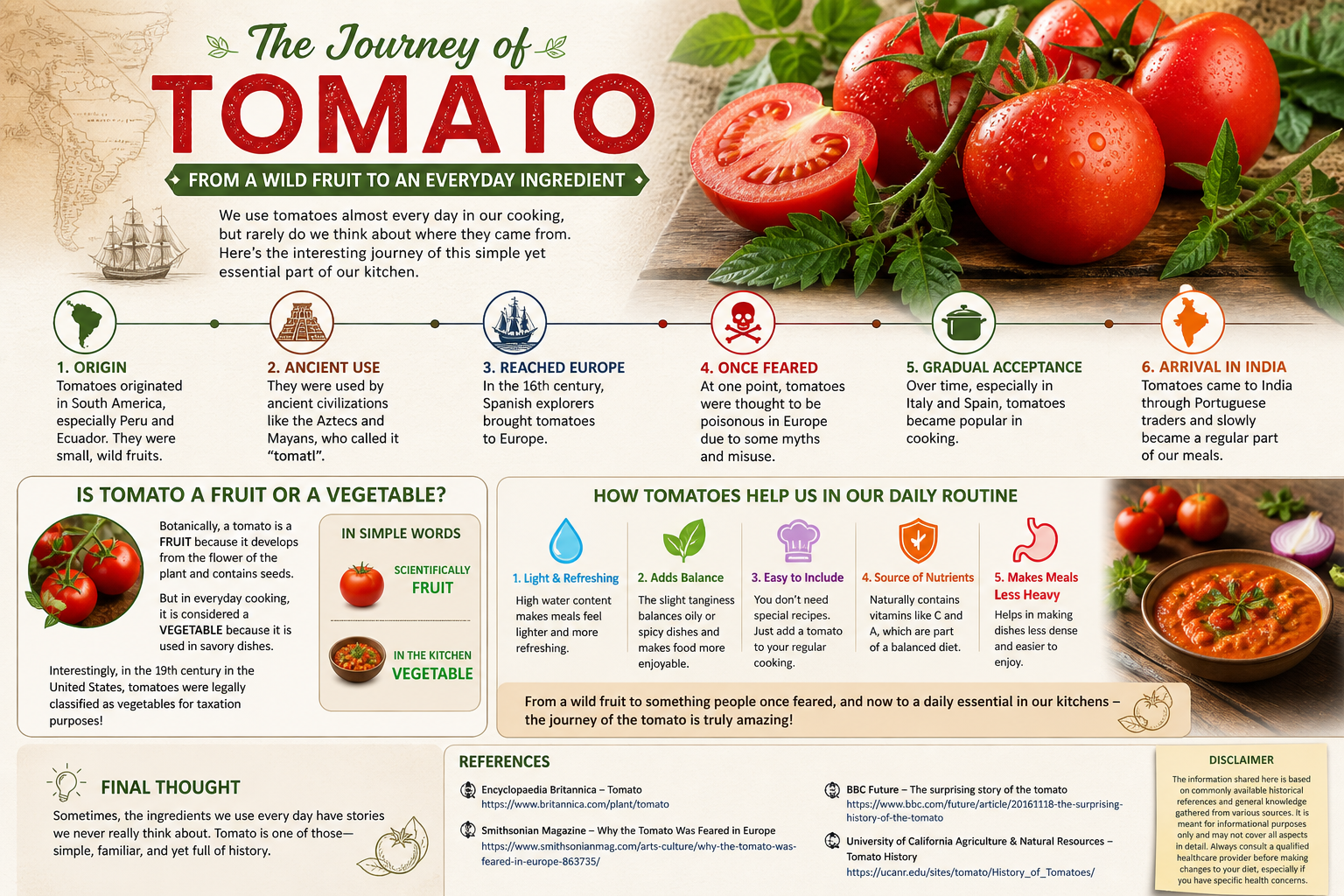
    They come from parts of South America, especially regions like Peru and Ecuador.

    In their early form, they were small, wild fruits—not exactly like the tomatoes we see today.

    🏺 Used by Ancient Civilizations

    Before spreading across the world, tomatoes were used by ancient civilizations like the Aztecs and Mayans.

    They even had a word for it—“tomatl”—which is believed to be the origin of the word tomato.

    🚢 How Tomatoes Reached Europe

    In the 16th century, Spanish explorers brought tomatoes to Europe.

    But instead of being accepted immediately, tomatoes were viewed with hesitation.

    People were unsure about this unfamiliar fruit.

    ⚠️ When Tomatoes Were Considered Harmful

    At one point, tomatoes were believed to be poisonous in Europe.

    This belief came from their resemblance to certain toxic plants. In some cases, people also fell sick after eating them—later it was understood that it had more to do with the utensils used at the time rather than the tomato itself.

    Still, this idea stayed for quite a while.

    🍝 Gradual Acceptance Over Time

    Slowly, countries like Italy and Spain started using tomatoes in cooking.

    Over time, they became an essential part of many cuisines—especially in dishes like sauces and gravies.

    🇮🇳 Arrival of Tomato in India

    Tomatoes were introduced to India by Portuguese traders.

    Initially, they were not commonly used.

    But gradually, they became part of everyday cooking—especially in:

    Curries
    Gravies
    Chutneys

    Today, it’s hard to imagine Indian food without them.

    🍅 Is Tomato a Fruit or a Vegetable?

    This is one of those questions that often comes up.

    From a botanical point of view, a tomato is actually a fruit because it develops from the flower of the plant and contains seeds.

    But in everyday cooking, it is treated as a vegetable because of how it’s used—mostly in savory dishes rather than sweet ones.

    Interestingly, this confusion even led to a legal case in the United States in the 19th century, where tomatoes were officially classified as vegetables for taxation purposes.

    👉 So in a simple way:

    🌿 Scientifically → Fruit
    🍛 In the kitchen → Vegetable
    🍛 How Tomatoes Fit Into Our Daily Routine

    What makes tomatoes interesting is how easily they fit into daily meals.

    They are already part of:

    Breakfast dishes like poha or upma
    Lunch dals and sabzis
    Simple salads or snacks

    They don’t feel heavy and blend naturally into food, which makes them easy to include regularly.

    Simple Benefits of Tomatoes in Daily Life

    Without going into anything complex, tomatoes offer a few simple, noticeable benefits:

    💧 1. Feel Light and Refreshing

    Tomatoes have a high water content, which can make meals feel lighter.

    🌿 2. Add Balance to Food

    Their slight tanginess helps balance oily or spicy dishes, making meals feel more complete.

    🥗 3. Easy to Include

    You don’t need special recipes—just adding a tomato to your regular cooking is enough.

    🍅 4. Naturally Provide Nutrients

    Tomatoes contain vitamins like C and A, which are part of a balanced diet.

    ⚖️ 5. Make Meals Feel Less Heavy

    When added to dishes, they often make food feel less dense and easier to enjoy.

    🌿 A Small Reflection

    Reading about this made me look at something as simple as a tomato a little differently.

    It’s interesting how something that once traveled across continents—and was even avoided at one point—has now become such a regular part of our meals.

    🌟 Final Thought

    Sometimes, the ingredients we use daily have stories we never really think about.

    Tomato is one of those—simple, familiar, and yet full of history.

    📚 References
    Encyclopedia Britannica – Tomato
    https://www.britannica.com/plant/tomato
    Smithsonian Magazine – Why the Tomato Was Feared in Europe
    https://www.smithsonianmag.com/arts-culture/why-the-tomato-was-feared-in-europe-863735/

    ⚠️ Disclaimer

    The information shared here is based on commonly available historical references and general knowledge gathered from various sources. It is meant for informational purposes only and may not cover all aspects in detail. Always consult a qualified healthcare provider before making changes to your diet, especially if you have specific health concerns.
  • The Journey of Carrot

    The Journey of Carrot

    🥕 The Journey of Carrot

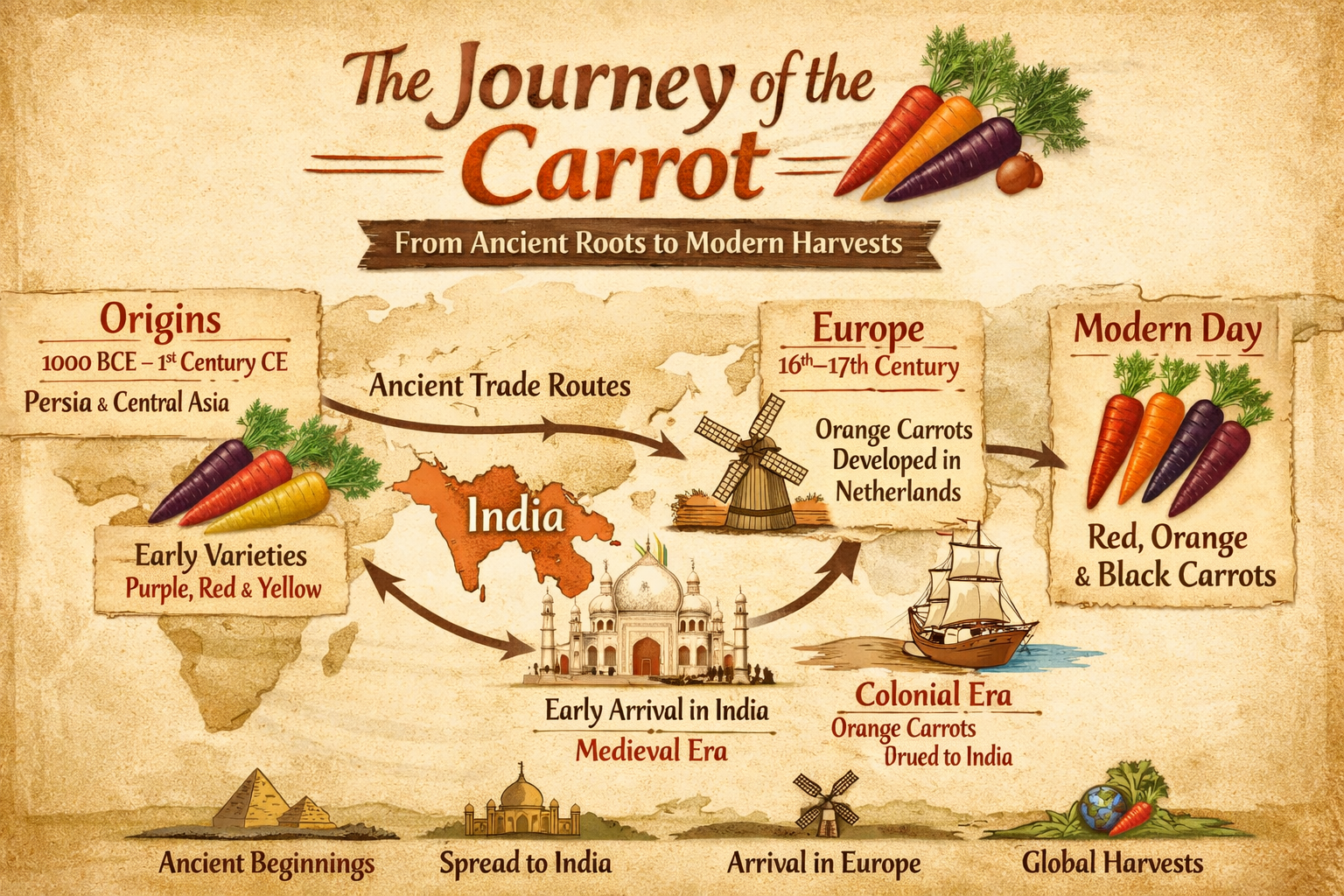
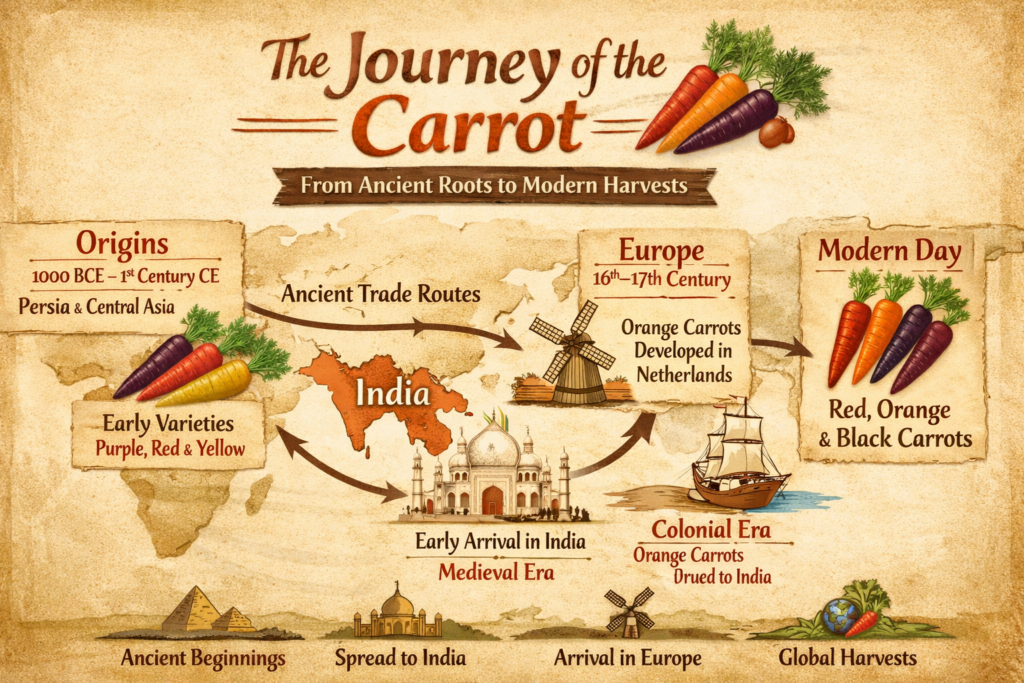
    Carrots sit quietly in our kitchens—humble, familiar, and often overlooked. Yet behind this everyday vegetable lies a story that stretches across centuries and continents. It’s a journey of color, cultivation, culture, and quiet transformation.


    🌍 Where It All Began

    Long before carrots turned orange, they grew wild in the rugged lands of Persia and Afghanistan. These early carrots looked nothing like the ones we know today. They were slender, often twisted, and came in deep shades of purple, red, and yellow.

    Interestingly, people didn’t grow them for the root at first. It was the leaves and seeds—aromatic and medicinal—that were valued. The root, now the star of countless dishes, was just an afterthought.

    As trade routes expanded, so did the carrot’s journey. Slowly, it traveled eastward, eventually finding its way into the fertile lands of India.


    🇮🇳 Carrots Find a Home in India

    In India, carrots didn’t just arrive—they adapted, evolved, and became part of everyday life.

    The red carrot, in particular, thrived in North India’s winter climate. Juicier, sweeter, and richer in flavor, it became deeply tied to seasonal cooking and tradition. Markets would fill with vibrant red bundles, signaling the arrival of winter.

    Much later, during the colonial period, a new variety appeared—the now-familiar orange carrot, developed in Europe, especially in the Netherlands. Over time, it spread across India, becoming a year-round staple.

    Yet even today, the red carrot holds a special place in Indian hearts and kitchens.


    😋 A Taste That Transforms

    Bite into a raw carrot, and you’ll notice its crisp texture and gentle sweetness, with a hint of earthiness. It’s refreshing, simple, and satisfying.

    But cooking tells a different story.

    Heat softens the carrot, deepens its sweetness, and unlocks a richness that feels almost indulgent. The red carrot, especially, becomes intensely flavorful—perfect for desserts and traditional dishes—while orange carrots remain milder and versatile.

    Then there are the darker varieties, like black or purple carrots, with their bold, earthy tones, often reserved for special preparations.


    🍲 From Kitchen Staple to Cultural Icon

    Across India and beyond, carrots slip effortlessly into both simple meals and celebratory dishes.

    In Indian homes, they shine in:

    • Warm, comforting gajar ka halwa, slow-cooked to perfection
    • Lightly spiced carrot sabzi, served with everyday meals
    • Tangy, bold carrot pickle, rich with spices
    • Traditional kanji, a fermented drink made from black carrots

    Elsewhere in the world, carrots add life to soups, stews, salads, roasted platters, and even desserts like carrot cake.

    Few vegetables move so easily between the ordinary and the festive.


    💪 Nature’s Quiet Healer

    Beyond taste and tradition, carrots carry remarkable nutritional strength.

    Rich in beta-carotene, they help the body produce vitamin A—essential for vision, immunity, and skin health. Their fiber supports digestion, while antioxidants and minerals contribute to heart health and overall well-being.

    In traditional Indian practices, especially, carrots—particularly black ones—are valued for their role in gut health, often consumed in fermented forms.

    It’s nourishment, offered simply.


    Little Secrets Hidden in a Common Root

    Even the most familiar foods carry surprises, and carrots are no exception.

    • They were once grown more for their leaves and seeds than their roots
    • The bright orange carrot is a relatively recent creation, shaped by European cultivation
    • Purple carrots contain powerful antioxidants similar to those found in berries
    • Early carrots were far less appealing—bitter, tough, and woody—before centuries of careful cultivation transformed them
    • Despite India being a major producer today, the most traditional variety here remains red, not orange

    These small details remind us how much history can hide in plain sight.


    🌱 A Story Still Growing

    From wild, colorful roots in ancient lands to the vibrant markets of India, the carrot’s journey is far from ordinary. It has changed shape, color, and purpose—yet remained a constant presence across time.

    Today, whether it’s grated into a rich halwa, stirred into a simple sabzi, or eaten fresh and raw, the carrot continues to connect past and present.

    A quiet vegetable, perhaps—but one with a story worth savoring.

  • The Story of Potato in India

    The Story of Potato in India

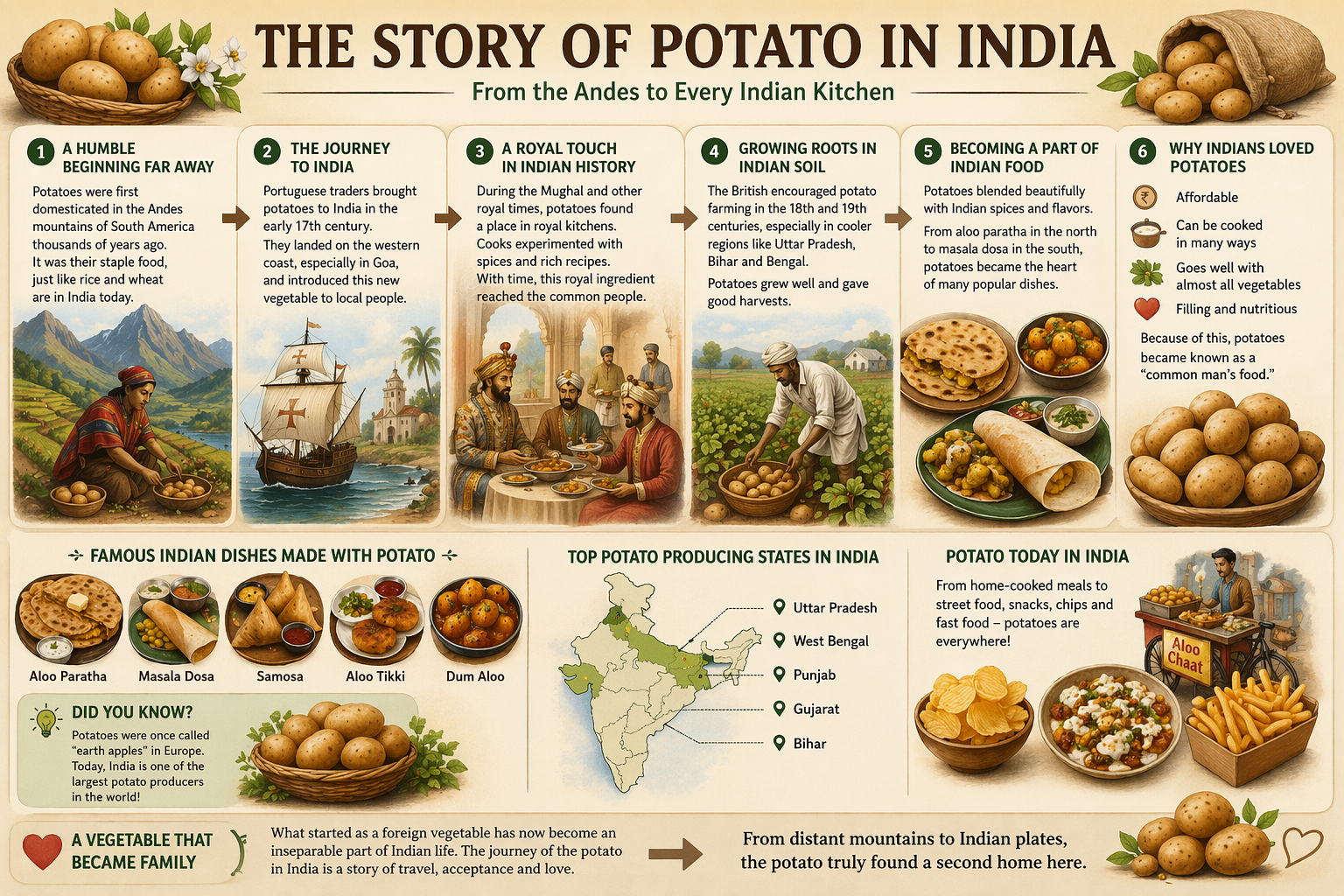
    🌍 A Humble Beginning Far Away

    Long before the potato became a part of Indian kitchens, it was growing quietly in the Andes mountains of South America. People there had been eating potatoes for thousands of years. It was their staple food, just like rice and wheat are in India today.

    🚢 The Journey to India

    The potato did not originally belong to India. It was brought here by Portuguese traders in the early 17th century. They arrived on the western coast, especially in Goa, and introduced this new vegetable to local people.

    At first, many Indians were unsure. A vegetable that grows underground felt strange. Some even avoided it. But slowly, people began to try it, and curiosity turned into acceptance.

    👑 A Royal Touch in Indian History

    There is no strong record of a single king or maharaja introducing potatoes in India, but during the Mughal and later regional kingdoms, new foods were often accepted in royal kitchens first.

    It is believed that in some royal courts, especially in North India, cooks began experimenting with potatoes by mixing them with rich spices, dry fruits, and gravies. Once royal kitchens accepted a food, it often spread to common people.

    Later, during British rule, potatoes became more organized as a crop and were grown in large quantities. This helped them move from royal kitchens to everyday homes.

    🌱 Growing Roots in Indian Soil

    The British played an important role in spreading potatoes across India in the 18th and 19th centuries. They encouraged farming in regions like Uttar Pradesh, Bihar, and Bengal.

    Potatoes grew well in Indian soil. Farmers liked them because they were easy to grow and gave good harvests. Slowly, potato farming became common.

    🍛 Becoming a Part of Indian Food

    Over time, potatoes became a favorite ingredient in Indian cooking. One big reason was their ability to absorb spices and flavors.

    Many famous Indian dishes were either created or improved using potatoes. For example:

    Aloo Paratha – A stuffed flatbread loved in North India
    Masala Dosa – A South Indian dish where spicy potato filling became the heart of the dosa
    Samosa – Originally from Central Asia, but in India, the potato filling made it popular
    Aloo Tikki – A crispy street food snack
    Dum Aloo – A rich curry often linked with Kashmiri and Mughlai styles

    In many of these dishes, potatoes became the main hero.

    💡 Why Indians Loved Potatoes

    There are simple reasons why potatoes became so popular:

    They are affordable
    They can be cooked in many ways
    They mix well with other vegetables
    They are filling and give energy

    Because of this, potatoes became known as the “common man’s food.”

    📈 Potato Today in India

    Today, India is one of the largest producers of potatoes in the world. States like Uttar Pradesh, West Bengal, and Punjab grow huge quantities every year.

    Potatoes are used everywhere—from homemade curries to street food like chaat, and even in chips and fast food.

    ❤️ A Vegetable That Became Family

    What started as a foreign vegetable has now become a part of every Indian kitchen. From royal recipes to simple home meals, potatoes have found a place in every heart.

    The journey of the potato in India is not just about food—it is a story of travel, acceptance, and creativity. From distant mountains to Indian plates, the potato truly found a second home here.