
🔐 Locks in India: Stories Hidden Behind Every Click
There’s a moment we all know.
You shut the door… turn the key… and hear that soft click.
It feels ordinary. Automatic.
But what if that tiny sound carried thousands of years of human cleverness?
Because in India, locks were never just objects.
They were puzzles, artworks, and silent guardians—each with a story to tell.
🏺 Before Iron and Steel—When Intelligence Was the Only Tool
Long before metal locks existed, people in India were already solving a complex problem:
How do you keep something safe without being there?
The answer wasn’t brute force—it was design.
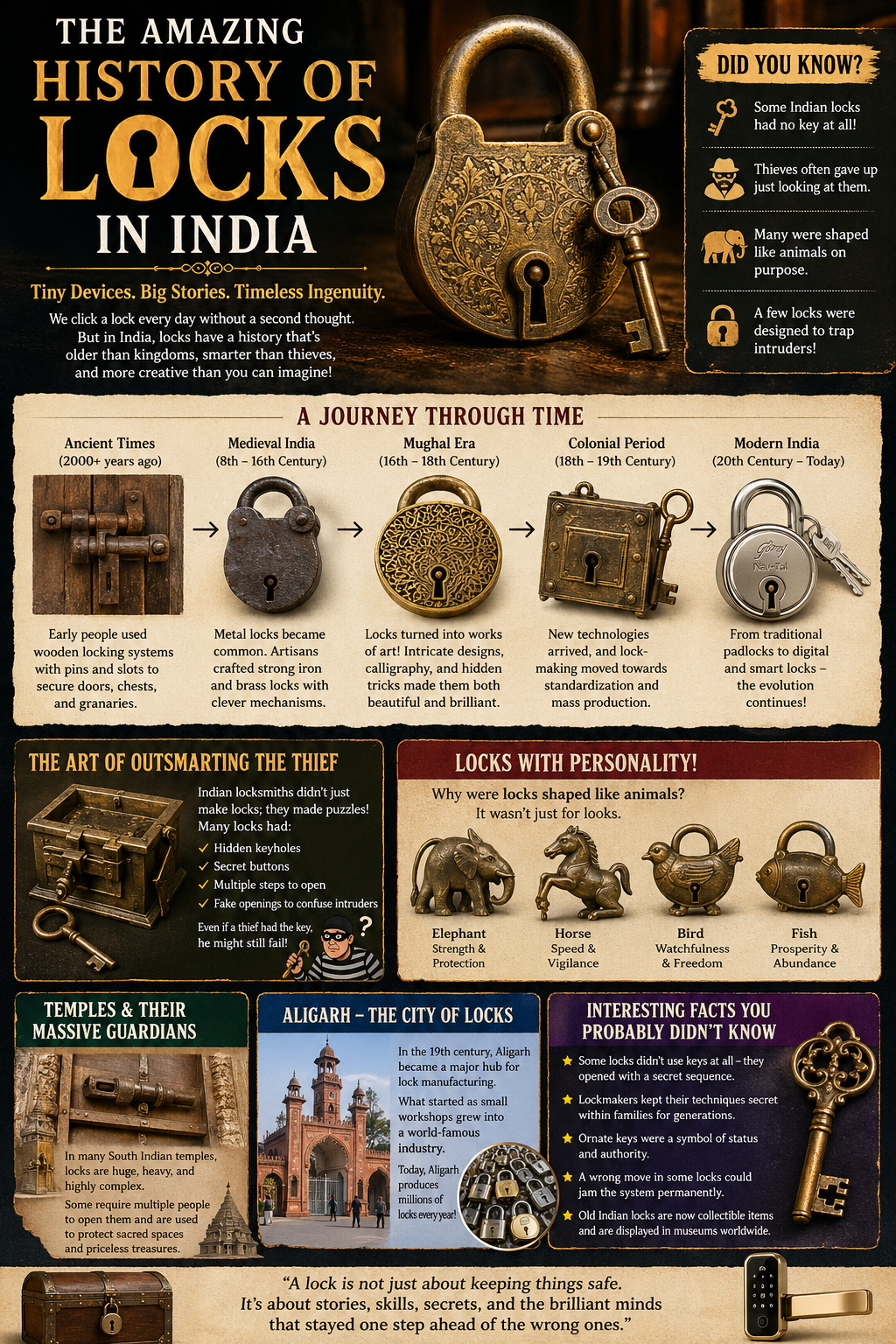
Early locks were made of wood, using sliding pins and carefully fitted parts. They didn’t look impressive, but they worked. These simple mechanisms protected food, valuables, and daily essentials.
What’s striking is this:
Even without advanced tools, people understood that security is not about strength—it’s about thinking ahead.
⚒️ When Locks Became More Than Protection
As metalworking grew, locks began to change.
They didn’t just protect anymore—they expressed something.
Craftsmen started shaping locks into animals and symbols. An elephant-shaped lock wasn’t random—it represented strength. A bird symbolized watchfulness.
Suddenly, a lock wasn’t just hanging on a door.
It was saying something about the person behind it.
And no two locks were exactly the same. Each one carried the touch of its maker.
🧠 The Game Between the Lockmaker and the Thief
This is where things get fascinating.
Indian locksmiths didn’t just build locks to stop thieves.
They built them to confuse them.
Some locks had:
Hidden buttons you had to press while turning the key
Keyholes that weren’t real
Mechanisms that only worked in a specific sequence
Even if someone had the correct key, that didn’t guarantee success.
Imagine being a thief, confident you’ve cracked the system…
only to realize the lock is playing a game you don’t understand.
Some locks would even jam permanently if handled incorrectly—leaving clear evidence of tampering.
It wasn’t just security.
It was psychology.
👨🔧 A Craft Built on Secrets
Lockmaking was never just a trade—it was guarded knowledge.
Skills were passed down quietly within families. Techniques weren’t written in books or shared openly. You learned by watching, practicing, and earning trust.
This created something rare:
Locks that weren’t mass-produced, but deeply personal.
Each one had its own logic. Its own behavior. Its own secret.
🛕 The Locks That Guarded More Than Wealth
In temples across India, locks took on a different meaning.
They weren’t just protecting objects—they were guarding belief, devotion, and sacred spaces.
These locks were often:
Large and heavy
Mechanically complex
Built to last for generations
Opening them wasn’t just an action.
It felt like entering something important.
🏭 From Handmade to Millions: The Rise of Aligarh
Over time, the world changed—and so did locks.
Production shifted from individual craftsmen to organized manufacturing. At the center of this shift was one city: Aligarh.
What began as small workshops grew into a major industry. Today, Aligarh is known across India for its lock production.
And yet, behind every modern lock, there’s still a trace of that older idea:
security through smart design.
🤯 Small Details That Make Locks Surprisingly Fascinating
Look closer, and locks reveal unexpected stories:
Some didn’t need keys at all—only secret movements.
Some were designed to mislead, not just resist.
Some signaled authority—holding keys meant holding responsibility.
And many, today, sit in museums—not as tools, but as art.
📱 From Metal to Memory—The Evolution Continues
Today, locks respond to fingerprints, codes, and even smartphones.
They’ve become faster, smarter, and less visible.
But at their core, nothing has changed.
A lock still asks the same question it always has:
Who is allowed in—and who isn’t?
✨ The Thought That Stays With You
The next time you lock something, pause for a second.
That simple action connects you to centuries of innovation, craftsmanship, and human curiosity.
Because a lock isn’t just about keeping something closed.
It’s about trust, control… and the quiet battle between those who protect and those who try to break in.