
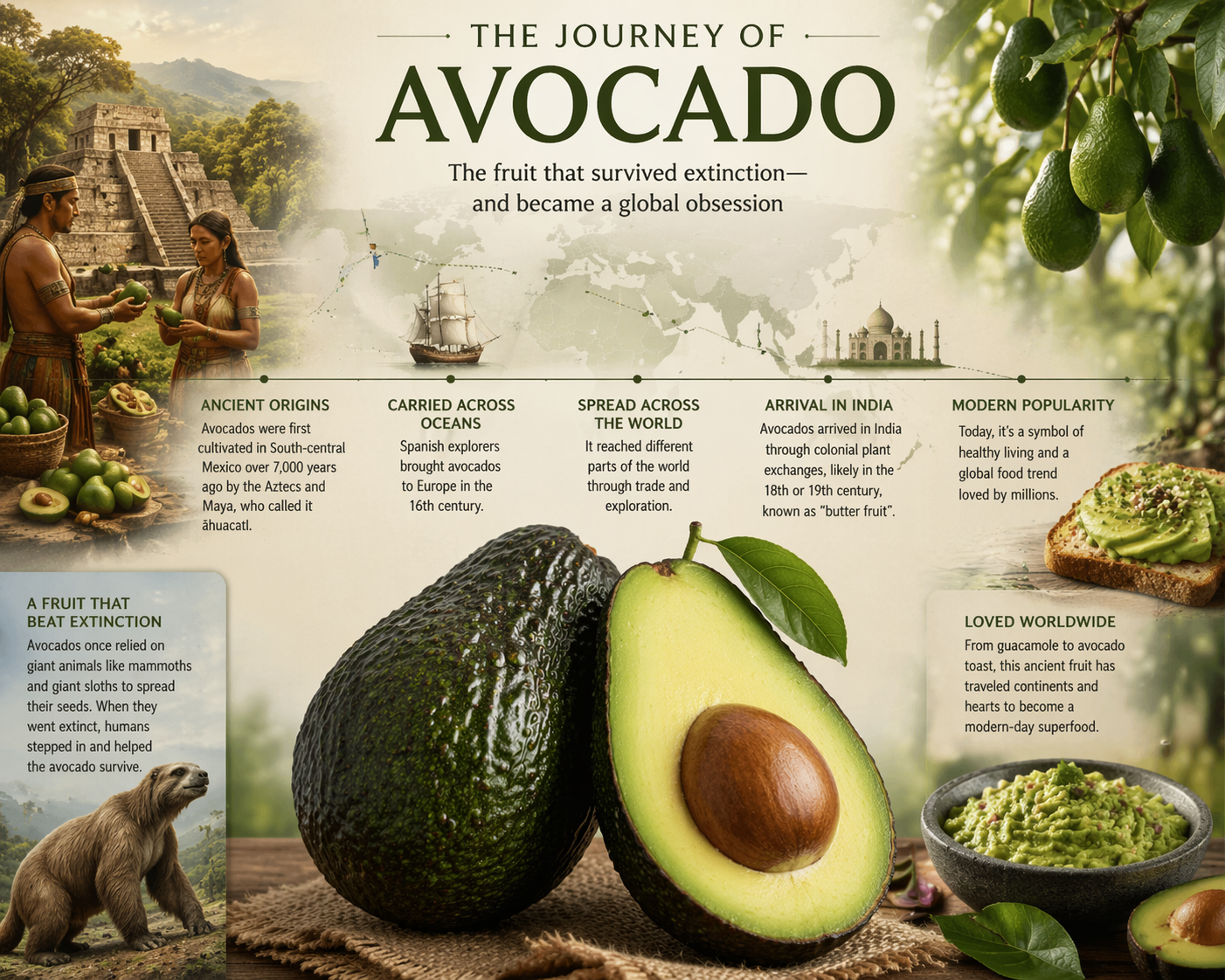
Today, avocados are slowly finding their place in Indian kitchens—blended into smoothies, spread on toast, or added to salads. But this fruit didn’t originate anywhere near the subcontinent. Its journey to India is a story of exploration, adaptation, and changing tastes.
Roots in the Americas
The avocado began its life in south-central Mexico, where it was cultivated by ancient civilizations like the Aztecs and Maya thousands of years ago. For centuries, it remained largely confined to the Americas, thriving in tropical and subtropical climates.
Carried Across Oceans
The turning point came in the 16th century, when Spanish explorers transported avocados beyond the Americas. From there, the fruit slowly spread to different parts of the world, including Southeast Asia.
It is believed that avocados reached India through trade routes and colonial plant exchanges, likely in the 18th or 19th century. However, unlike in some other regions, the fruit didn’t immediately become popular.
A Different Identity in India
In India, avocados are often known as “butter fruit.” This name reflects their creamy texture rather than their origin.
The fruit found a natural home in regions with suitable climates, particularly:
- Karnataka (especially Coorg)
- Kerala
- Tamil Nadu
- Parts of the northeastern states
Despite this, avocados remained relatively unknown to much of the population for a long time.
Why Didn’t It Catch On Earlier?
Unlike staples such as mangoes or bananas, avocados didn’t fit easily into traditional Indian cuisine. Their mild flavor and unfamiliar texture made them less appealing compared to the bold, spiced foods people were used to.
There was also limited large-scale cultivation, which kept availability low.
The Modern Shift
In recent years, the avocado has seen a rise in popularity across India. This shift is driven by:
- Growing awareness of health and nutrition
- Global food trends and social media influence
- Increasing exposure to international cuisines
Urban areas, in particular, have embraced the fruit, incorporating it into both Western-style dishes and new Indian fusion recipes