Category: History

  • Gud (Jaggery): The Traditional Sweetness That Existed Before Modern Sugar

    Gud (Jaggery): The Traditional Sweetness That Existed Before Modern Sugar

    Sugar feels so normal today that it’s difficult to imagine a time when it wasn’t part of everyday life.

    It quietly exists in:

    • tea
    • sweets
    • packaged snacks
    • desserts
    • almost every kitchen shelf

    But while reading more about traditional foods and older eating habits, I came across something interesting:

    Before refined white sugar became widely common, many households across India relied far more on gud (jaggery) for sweetness.

    And the more I explored its history, the more it felt like gud was never just about taste. It was connected with:

    • farming traditions
    • seasonal eating
    • homemade recipes
    • festivals
    • and everyday village life.

    So I thought it would be interesting to bring together some of these details in one place.


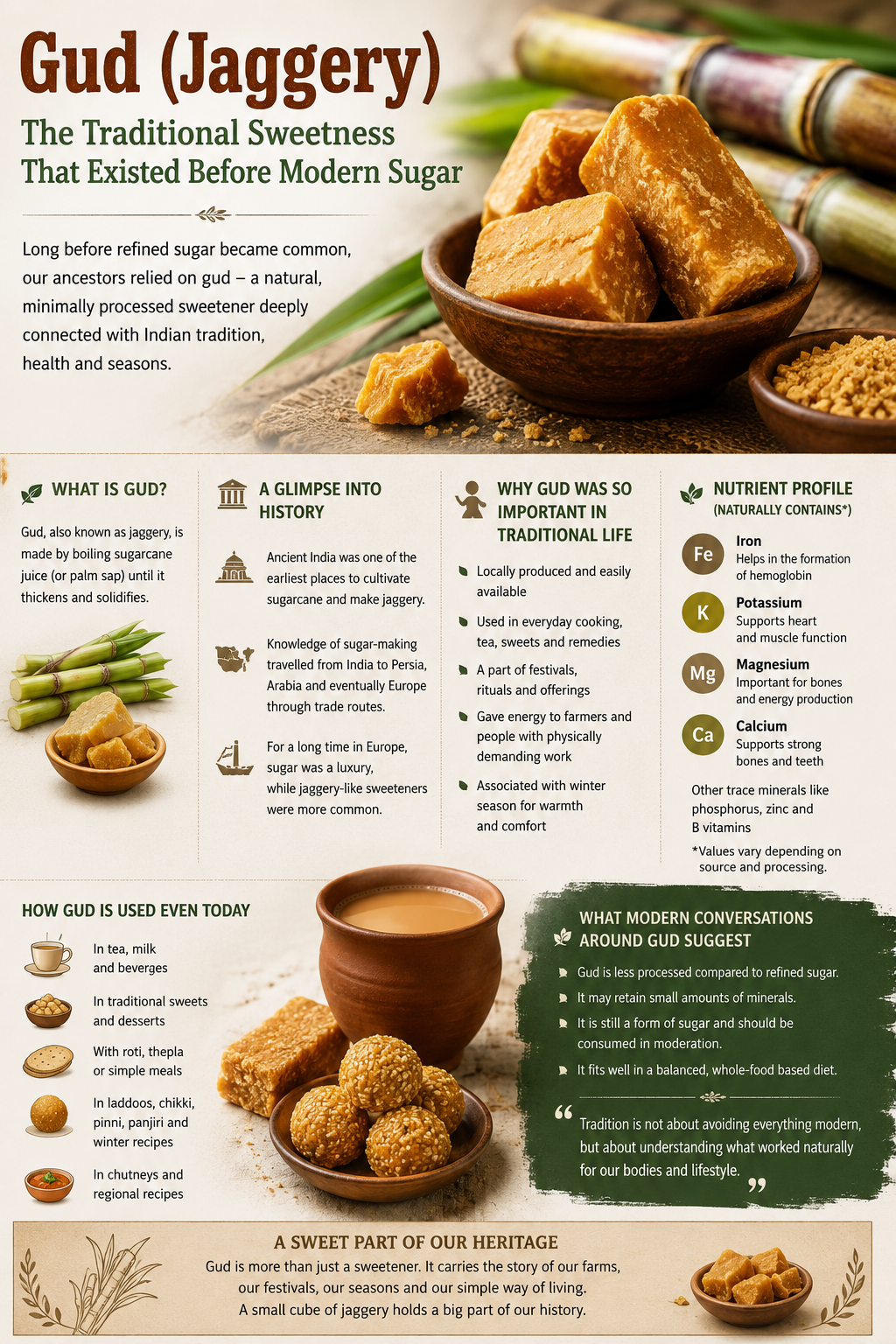
    🌾 What Exactly Is Gud?

    Gud, also known as jaggery, is traditionally made by slowly boiling sugarcane juice until it thickens and solidifies.

    In some regions, jaggery is also prepared from:

    • date palm
    • coconut palm

    Unlike refined sugar, gud usually goes through much less processing.

    That’s why it keeps:

    • its golden or brown color
    • deeper taste
    • slightly earthy flavor

    And maybe that’s one reason older generations often viewed it differently from ordinary sugar.


    🏺 India’s Deep Connection with Sugarcane and Gud

    One detail that really stood out while reading about gud was how strongly India is connected with the early history of sugarcane and sweet-making.

    Historical references suggest that ancient India was among the earliest places where people:

    • cultivated sugarcane extensively
    • extracted sugarcane juice
    • developed early sweeteners like jaggery

    Before modern sugar factories existed, gud was already being prepared and used in everyday life.

    Over time, knowledge of sugar processing gradually spread through:

    • traders
    • travelers
    • trade routes

    moving from India toward:

    • Persia
    • the Arab world
    • and eventually Europe.

    🍬 Before White Sugar Became Common

    Another interesting thing is that refined white sugar was once rare and expensive in many parts of the world.

    For a long time, people depended more on:

    • honey
    • fruits
    • jaggery-like sweeteners

    In India especially, gud naturally became part of:

    • homemade sweets
    • tea
    • winter recipes
    • festive food
    • farming households

    And because it was locally prepared, it stayed closely connected with rural food traditions.


    ❄️ Why Gud Became Closely Linked with Winters

    One pattern I noticed while reading about traditional Indian food habits is how closely foods were connected with seasons.

    Gud often appeared in:

    • til laddoos
    • chikki
    • panjiri
    • winter sweets

    Older traditions frequently described it as:

    • warming
    • comforting
    • satisfying during colder months

    Even today, many families naturally start using gud more during winter.


    🌿 What Nutrients Does Gud Naturally Contain?

    Because jaggery is less refined than white sugar, it may retain small amounts of naturally occurring minerals.

    Depending on the preparation, gud can contain traces of:

    • iron
    • potassium
    • magnesium
    • calcium

    Of course, it is still a sweetener and naturally contains sugar.

    But what I found interesting is that modern discussions often describe gud less as a “miracle food” and more as a traditional ingredient connected with older eating patterns.


    🧠 What Current Conversations Around Gud Seem to Suggest

    While exploring more recent discussions around jaggery, I noticed that the conversation today feels very different from older times.

    Instead of dividing foods strictly into “good” and “bad,” many current discussions seem more focused on:

    • moderation
    • less processed foods
    • traditional preparation methods
    • balanced eating habits

    Gud often appears in these conversations because of:

    • its traditional preparation
    • richer taste
    • connection with homemade food culture

    At the same time, many sources also mention that gud is still a form of sugar and is best understood in balance rather than through extreme claims.

    That balanced perspective honestly felt more realistic and interesting to me.


    🍛 How Gud Quietly Stayed Part of Everyday Life

    What surprised me most is how naturally gud still fits into daily routines in many homes.

    Even today, people continue using it:

    • with roti
    • in tea
    • in homemade sweets
    • after meals
    • during winter evenings

    And despite modern packaged foods becoming more common, gud still somehow feels connected with slower, older styles of eating.


    🌟 A Small Reflection

    Reading about gud made me realize how many traditional foods quietly survived across generations not because they were heavily promoted, but because they naturally fit into people’s lifestyles.

    Sometimes, food history says as much about culture and everyday life as it does about nutrition.


    🍯 Final Thought

    Gud may look simple, but behind it is a long story of sugarcane farming, seasonal eating, village traditions, trade routes, and changing food habits.

    And maybe that’s why it still feels more connected to tradition than ordinary sweetness does.


    📚 References


    ⚠️ Disclaimer

    The information shared here is based on historical references, cultural observations, and general reading from publicly available sources. It is meant for informational purposes only and should not be considered medical or dietary advice.
  • The Story of Mango: How It Became India’s Most Loved Summer Fruit

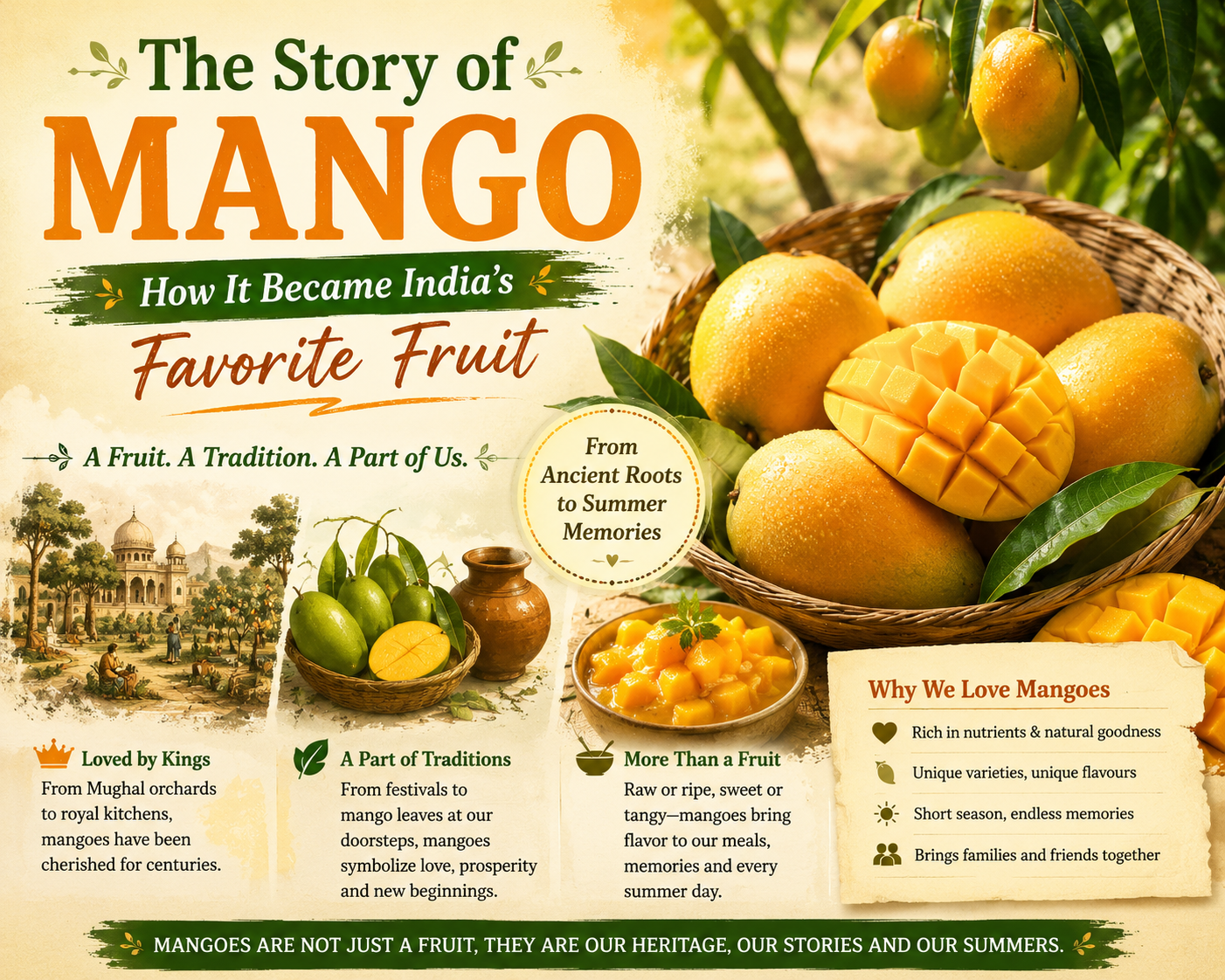
    The Story of Mango: How It Became India’s Most Loved Summer Fruit

    There’s something different about mango season in India.

    The moment mangoes begin appearing in markets, everything changes a little.

    People start discussing:

    • Which variety arrived first
    • Whether Alphonso is better than Dasheri
    • How sweet this year’s mangoes are
    • And when homemade pickles will finally be ready

    Very few foods create this kind of excitement.

    And while reading more about the history of everyday foods, I realized something interesting:

    👉 Mango is not just a fruit in India.
    It has quietly become part of memories, traditions, festivals, and even emotions across generations.

    So I thought it would be interesting to gather some of these details together in one place.


    🌳 A Fruit That Has Been Around for Thousands of Years

    Mango is believed to have originated around the Indian subcontinent and nearby regions of South Asia.

    Historical references suggest that mangoes were cultivated in India thousands of years ago.

    Which means long before modern supermarkets and fruit packaging existed, mango trees were already part of Indian landscapes.

    Over time, the fruit slowly became connected with:

    • Summer traditions
    • Hospitality
    • Seasonal eating habits
    • Family gatherings

    And somehow, that connection still exists today.


    👑 Even Kings Were Fascinated by Mangoes

    One detail that really stood out to me was how much mangoes were admired during royal times.

    During the Mughal era, mango cultivation became extremely popular.

    Emperor Akbar is believed to have planted a massive mango orchard called Lakhi Bagh, which reportedly had thousands of mango trees.

    It’s interesting to think that a fruit we casually cut and eat today was once so admired by kings and royal courts.


    🥭 India Didn’t Just Grow Mangoes — It Created Mango Personalities

    One of the most fascinating things about mangoes is how every region developed its own favorite variety.

    And people become surprisingly loyal to them.

    Some famous varieties include:

    • Alphonso from Maharashtra
    • Dasheri from Uttar Pradesh
    • Langra from Varanasi
    • Kesar from Gujarat
    • Banganapalli from Andhra Pradesh

    And if you ask people which one is best, the debate can go on for hours.

    Because for many people, mangoes are personal.


    ☀️ Why Mango Season Feels Emotional

    Unlike fruits available throughout the year, mangoes arrive for a limited time.

    Maybe that’s part of what makes them special.

    For many families, summer memories are tied to:

    • Eating chilled mango slices in the afternoon
    • Drinking aam panna during hot days
    • Watching elders prepare mango pickle jars
    • Storing boxes of mangoes wrapped in newspaper at home

    Even the smell of ripe mangoes can remind people of childhood summers.


    🍛 Mango Is More Versatile Than We Realize

    Another thing I found interesting is how differently mango is used across India.

    🥭 Raw Mango

    Used in:

    • Pickles
    • Chutneys
    • Aam panna
    • Tangy summer dishes

    🌞 Ripe Mango

    Used in:

    • Milkshakes
    • Desserts
    • Aamras
    • Homemade sweets
    • Or simply eaten fresh

    Very few fruits fit into both spicy and sweet traditions so naturally.


    🌿 Mango Beyond Food

    Mangoes also became part of Indian traditions beyond eating.

    Even today:

    • Mango leaves are used during festivals
    • They are placed near entrances during celebrations
    • Mango motifs appear in Indian art and fabrics

    Which shows how deeply the fruit entered cultural life over time.


    Simple Benefits People Associate with Mango

    Without making things too technical, mangoes naturally contain:

    • Vitamin C
    • Vitamin A
    • Fiber
    • Natural sweetness

    And because they are seasonal, many people enjoy them as part of balanced summer eating rather than an everyday fruit.


    🧠 Why Mango Still Feels Different From Other Fruits

    Reading about mangoes made me realize something:

    People don’t just “consume” mangoes.

    They wait for them.

    They discuss them.
    Compare them.
    Gift them.
    Remember summers through them.

    And very few foods create that kind of emotional connection across an entire country.


    🌟 A Small Reflection

    From royal orchards to roadside fruit stalls, mango has traveled through centuries while still remaining deeply familiar.

    Maybe that’s why it continues to feel special no matter how common it becomes.


    🥭 Final Thought

    Some foods simply become part of our diet.

    Others slowly become part of culture, memories, and seasons.

    And mango seems to have become all three.


    📚 References


    ⚠️ Disclaimer

    The information shared here is based on commonly available historical references, cultural observations, and general reading. It is meant for informational purposes only and should not be considered medical advice or nutritional guidance.

  • The Journey of Tomato: From a Wild Fruit to an Everyday Ingredient

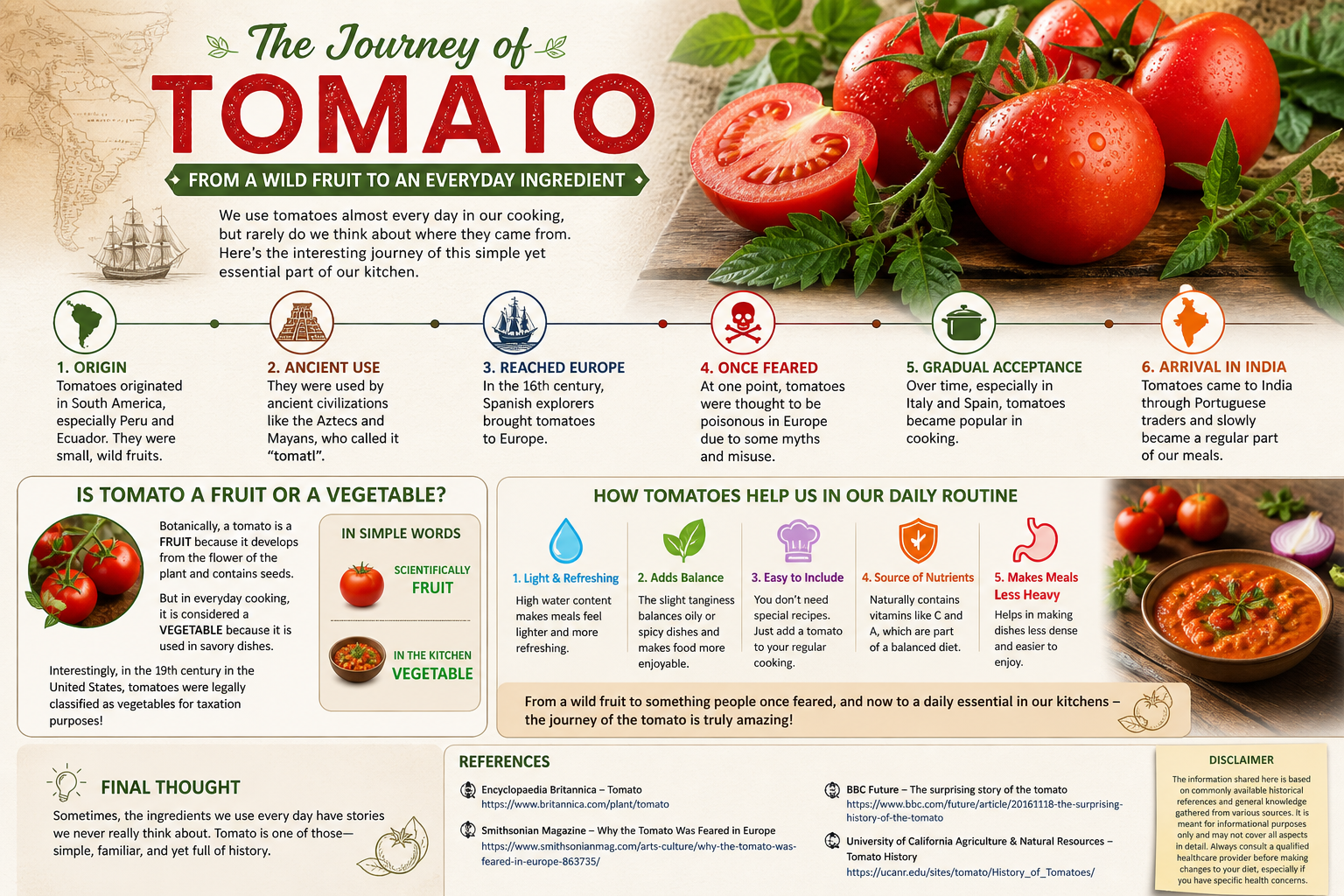
    The Journey of Tomato: From a Wild Fruit to an Everyday Ingredient

    We use tomatoes almost every day—whether it’s in dal, sabzi, or chutney.

    But rarely do we stop and think about where they actually came from.

    While exploring more about everyday foods, I came across some interesting details about tomatoes. It made me realize that something so common in our kitchen has had quite an unexpected journey.

    So I thought it would be nice to bring these details together in one place.

    🌎 Tomatoes Didn’t Originate in India

    One of the most surprising things is that tomatoes are not originally from India.

    They come from parts of South America, especially regions like Peru and Ecuador.

    In their early form, they were small, wild fruits—not exactly like the tomatoes we see today.

    🏺 Used by Ancient Civilizations

    Before spreading across the world, tomatoes were used by ancient civilizations like the Aztecs and Mayans.

    They even had a word for it—“tomatl”—which is believed to be the origin of the word tomato.

    🚢 How Tomatoes Reached Europe

    In the 16th century, Spanish explorers brought tomatoes to Europe.

    But instead of being accepted immediately, tomatoes were viewed with hesitation.

    People were unsure about this unfamiliar fruit.

    ⚠️ When Tomatoes Were Considered Harmful

    At one point, tomatoes were believed to be poisonous in Europe.

    This belief came from their resemblance to certain toxic plants. In some cases, people also fell sick after eating them—later it was understood that it had more to do with the utensils used at the time rather than the tomato itself.

    Still, this idea stayed for quite a while.

    🍝 Gradual Acceptance Over Time

    Slowly, countries like Italy and Spain started using tomatoes in cooking.

    Over time, they became an essential part of many cuisines—especially in dishes like sauces and gravies.

    🇮🇳 Arrival of Tomato in India

    Tomatoes were introduced to India by Portuguese traders.

    Initially, they were not commonly used.

    But gradually, they became part of everyday cooking—especially in:

    Curries
    Gravies
    Chutneys

    Today, it’s hard to imagine Indian food without them.

    🍅 Is Tomato a Fruit or a Vegetable?

    This is one of those questions that often comes up.

    From a botanical point of view, a tomato is actually a fruit because it develops from the flower of the plant and contains seeds.

    But in everyday cooking, it is treated as a vegetable because of how it’s used—mostly in savory dishes rather than sweet ones.

    Interestingly, this confusion even led to a legal case in the United States in the 19th century, where tomatoes were officially classified as vegetables for taxation purposes.

    👉 So in a simple way:

    🌿 Scientifically → Fruit
    🍛 In the kitchen → Vegetable
    🍛 How Tomatoes Fit Into Our Daily Routine

    What makes tomatoes interesting is how easily they fit into daily meals.

    They are already part of:

    Breakfast dishes like poha or upma
    Lunch dals and sabzis
    Simple salads or snacks

    They don’t feel heavy and blend naturally into food, which makes them easy to include regularly.

    Simple Benefits of Tomatoes in Daily Life

    Without going into anything complex, tomatoes offer a few simple, noticeable benefits:

    💧 1. Feel Light and Refreshing

    Tomatoes have a high water content, which can make meals feel lighter.

    🌿 2. Add Balance to Food

    Their slight tanginess helps balance oily or spicy dishes, making meals feel more complete.

    🥗 3. Easy to Include

    You don’t need special recipes—just adding a tomato to your regular cooking is enough.

    🍅 4. Naturally Provide Nutrients

    Tomatoes contain vitamins like C and A, which are part of a balanced diet.

    ⚖️ 5. Make Meals Feel Less Heavy

    When added to dishes, they often make food feel less dense and easier to enjoy.

    🌿 A Small Reflection

    Reading about this made me look at something as simple as a tomato a little differently.

    It’s interesting how something that once traveled across continents—and was even avoided at one point—has now become such a regular part of our meals.

    🌟 Final Thought

    Sometimes, the ingredients we use daily have stories we never really think about.

    Tomato is one of those—simple, familiar, and yet full of history.

    📚 References
    Encyclopedia Britannica – Tomato
    https://www.britannica.com/plant/tomato
    Smithsonian Magazine – Why the Tomato Was Feared in Europe
    https://www.smithsonianmag.com/arts-culture/why-the-tomato-was-feared-in-europe-863735/

    ⚠️ Disclaimer

    The information shared here is based on commonly available historical references and general knowledge gathered from various sources. It is meant for informational purposes only and may not cover all aspects in detail. Always consult a qualified healthcare provider before making changes to your diet, especially if you have specific health concerns.

  • Locks in India: Stories Hidden Behind Every Click

    Locks in India: Stories Hidden Behind Every Click

    🔐 Locks in India: Stories Hidden Behind Every Click

    There’s a moment we all know.

    You shut the door… turn the key… and hear that soft click.
    It feels ordinary. Automatic.

    But what if that tiny sound carried thousands of years of human cleverness?

    Because in India, locks were never just objects.
    They were puzzles, artworks, and silent guardians—each with a story to tell.

    🏺 Before Iron and Steel—When Intelligence Was the Only Tool

    Long before metal locks existed, people in India were already solving a complex problem:

    How do you keep something safe without being there?

    The answer wasn’t brute force—it was design.

    Early locks were made of wood, using sliding pins and carefully fitted parts. They didn’t look impressive, but they worked. These simple mechanisms protected food, valuables, and daily essentials.

    What’s striking is this:
    Even without advanced tools, people understood that security is not about strength—it’s about thinking ahead.

    ⚒️ When Locks Became More Than Protection

    As metalworking grew, locks began to change.

    They didn’t just protect anymore—they expressed something.

    Craftsmen started shaping locks into animals and symbols. An elephant-shaped lock wasn’t random—it represented strength. A bird symbolized watchfulness.

    Suddenly, a lock wasn’t just hanging on a door.
    It was saying something about the person behind it.

    And no two locks were exactly the same. Each one carried the touch of its maker.

    🧠 The Game Between the Lockmaker and the Thief

    This is where things get fascinating.

    Indian locksmiths didn’t just build locks to stop thieves.
    They built them to confuse them.

    Some locks had:

    Hidden buttons you had to press while turning the key
    Keyholes that weren’t real
    Mechanisms that only worked in a specific sequence

    Even if someone had the correct key, that didn’t guarantee success.

    Imagine being a thief, confident you’ve cracked the system…
    only to realize the lock is playing a game you don’t understand.

    Some locks would even jam permanently if handled incorrectly—leaving clear evidence of tampering.

    It wasn’t just security.
    It was psychology.

    👨‍🔧 A Craft Built on Secrets

    Lockmaking was never just a trade—it was guarded knowledge.

    Skills were passed down quietly within families. Techniques weren’t written in books or shared openly. You learned by watching, practicing, and earning trust.

    This created something rare:
    Locks that weren’t mass-produced, but deeply personal.

    Each one had its own logic. Its own behavior. Its own secret.

    🛕 The Locks That Guarded More Than Wealth

    In temples across India, locks took on a different meaning.

    They weren’t just protecting objects—they were guarding belief, devotion, and sacred spaces.

    These locks were often:

    Large and heavy
    Mechanically complex
    Built to last for generations

    Opening them wasn’t just an action.
    It felt like entering something important.

    🏭 From Handmade to Millions: The Rise of Aligarh

    Over time, the world changed—and so did locks.

    Production shifted from individual craftsmen to organized manufacturing. At the center of this shift was one city: Aligarh.

    What began as small workshops grew into a major industry. Today, Aligarh is known across India for its lock production.

    And yet, behind every modern lock, there’s still a trace of that older idea:
    security through smart design.

    🤯 Small Details That Make Locks Surprisingly Fascinating

    Look closer, and locks reveal unexpected stories:

    Some didn’t need keys at all—only secret movements.
    Some were designed to mislead, not just resist.
    Some signaled authority—holding keys meant holding responsibility.
    And many, today, sit in museums—not as tools, but as art.

    📱 From Metal to Memory—The Evolution Continues

    Today, locks respond to fingerprints, codes, and even smartphones.

    They’ve become faster, smarter, and less visible.

    But at their core, nothing has changed.

    A lock still asks the same question it always has:

    Who is allowed in—and who isn’t?

    ✨ The Thought That Stays With You

    The next time you lock something, pause for a second.

    That simple action connects you to centuries of innovation, craftsmanship, and human curiosity.

    Because a lock isn’t just about keeping something closed.

    It’s about trust, control… and the quiet battle between those who protect and those who try to break in.